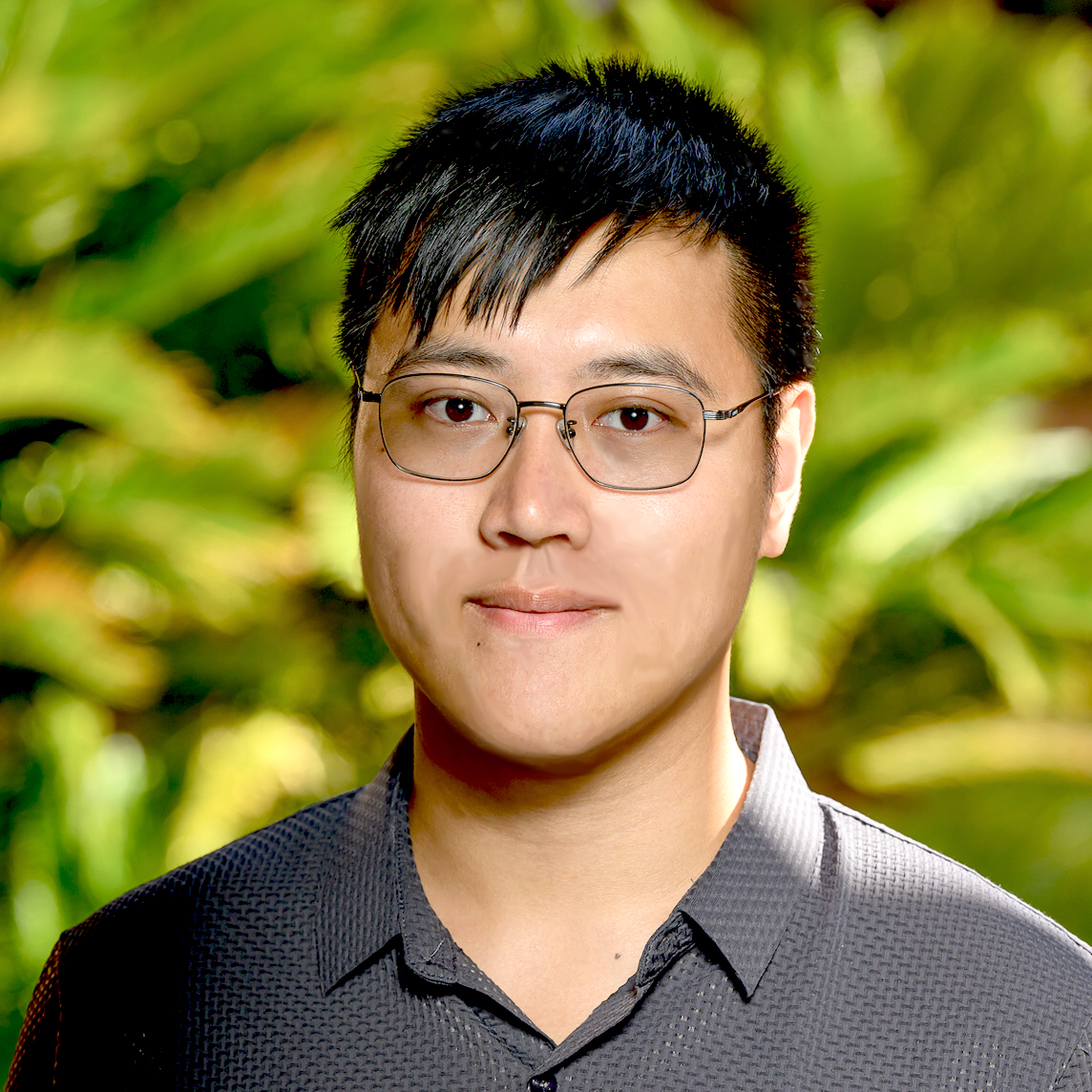
I’m a second-year Ph.D. student in Economic Analysis & Policy group at Stanford Graduate School of Business (GSB) with Ph.D. minor in Electrical Engineering. My Ph.D. fields are in Advanced Theory, Advanced Econometrics, and Market Design.
Previously, I received an M.S. degree in Computational and Mathematical Engineering (ICME) and a B.S. degree in Symbolic Systems (with honors) from Stanford University. I am honored to have Prof. Yuliy Sannikov as the advisor and Prof. Robert Wilson as the second reader for my undergraduate thesis.
ธนวัฒน์ ศรวณีย์
Research Interests
Economic Theory
Working Papers
1-Dimensional Normal Competitive Market Equilibrium
Thanawat Sornwanee.
Abstract: We introduce a new microeconomics foundation of a specific type of competitive market equilibrium that can be used to study several markets with information asymmetry such as commodity market, credit market, and insurance market. Score-Debiased Kernel Density Estimation, presented at ICLR Frontiers in Probabilistic Inference Workshop 2025.
Elliot Epstein*, Rajat Dwaraknath*, Thanawat Sornwanee*, John Winnicki, and Jerry Liu.
Abstract: We propose a novel method for density estimation that leverages an estimated score function to debias kernel density estimation (SD-KDE). In our approach, each data point is adjusted by taking a single step along the score function with a specific choice of step size, followed by standard KDE with a modified bandwidth. The step size and modified bandwidth are chosen to remove the leading order bias in the KDE. Our experiments on synthetic tasks in 1D, 2D and on MNIST, demonstrate that our proposed SD-KDE method significantly reduces the mean integrated squared error compared to the standard Silverman KDE, even with noisy estimates in the score function. These results underscore the potential of integrating score-based corrections into nonparametric density estimation. Reinforced Social Learning, presented at INFORMS Annual Meeting 2024.
Thanawat Sornwanee.
Abstract: I present a knowledge-free mechanism to ensure the zero asymptotic average regret in a sequential social learning framework with binary state of the world and homogeneous preference. This mechanism also ensures that the state of the world can be asymptotically learned, regardless of the choice of Nash equilibrium employed. The asymptotic optimality of the mechanism will also shown to be preserved under different economic scenarios, such as when each agent may be blinded from the history of actions and/or received a utility shock.Teaching & Services
Reviewer:
- ICML 2026 Emergency
- ICML 2026
- ICLR Workshop 2026: AI for Mechanism Design and Strategic Decision Making
Teaching:
- 2023 Workshop Assistant - Stanford ICME Workshop, Data Visualization
- 2022 Teaching Assisant - Stanford MS&E 339: Algorithms for Decntralized Finance
Grading:
- 2025 Stanford MGTECON 200: Managerial Economics
- 2024 Stanford ECON 202: Microeconomics I
- 2024 Stanford MS&E 232: Introduction to Game Theory
- 2023 Stanford EE 392F: Large-Scale Convex Optimization: Algorithms and Analyses via Monotone Operators
Services:
Awards
- Gold Medal, International Physics Olympiad (50th IPhO, Tel Aviv, Israel) [2019]
- Honorable Mentions, Asian Earth Science Olympiad (18th & 19th APhO, Yakutsk, Russia & Hanoi, Vietnam) [2017, 2018]
- Bronze Medal, International Earth Science Olympiad (10th IESO, Mie, Japan) [2016]
Talks & Presentations
2026
- “Matching the Mean: Informational Shrinkage in Crowdsourced Data Labelling” Market Design in the Age of AI Conference, Stanford, California
- “Who should Get Extra Reviews in the Age of AI” Market Design in the Age of AI Conference, Stanford, California
- “1-Dimensional Normal Competitive Market Equilibrium” Student Workshop-Theory Economics, Stanford, California
- (By Elliot Epstein) “Evaluating LLM Calibration on Confidence Intervals with FermiEval” AAAI 2026 Workshop, AI4Science: From Understanding Model Behavior to Discovering New Scientific Knowledge, Singapore
- (By Elliot Epstein) “LLMs are Overconfident: Evaluating Confidence Interval Calibration with FermiEval” AAAI 2026 Workshop, AIR-FM: Assessing and Improving Reliability of Foundation Models in the Real World, Singapore
2025
- “SD-KDE: Score-Debiased Kernel Density Estimation” NeuRIPS 2025, San Diego, California
- “Error Averaging in Backward Diffusion” Center for Decoding the Universe Quarterly Forum, Stanford, California
- “Approximately Correct Posterior Sampling for Inverse Problem with Diffusion” GSB Celebration of Scholarship, Stanford, California
- “Aligning Rational Superintelligences through Debate: A Game-Theoretic Framework” EC 2025 Workshop, Human-AI Collaboration, Stanford, California
- “Robust Bandit Learning with Delegation” EC 2025 Workshop, Online Learning and Economics, Stanford, California
- “Matching and Pricing on a Tree” EC 2025 Poster, Stanford, California
- “Score-Debiased Kernel Density Estimation” ICLR 2025 Workshop, Frontiers in Probabilistic Inference: Sampling Meets Learning, Singapore
- “Score-Debiased Kernel Density Estimation” Workshop on Experimental Design: AI for Science, Stanford, California
2024
- “Reinforced Social Learning” INFORMS Annual Meeting 2024, Seattle, Washington
Contact
Email: tsornwanee [at] stanford.edu